
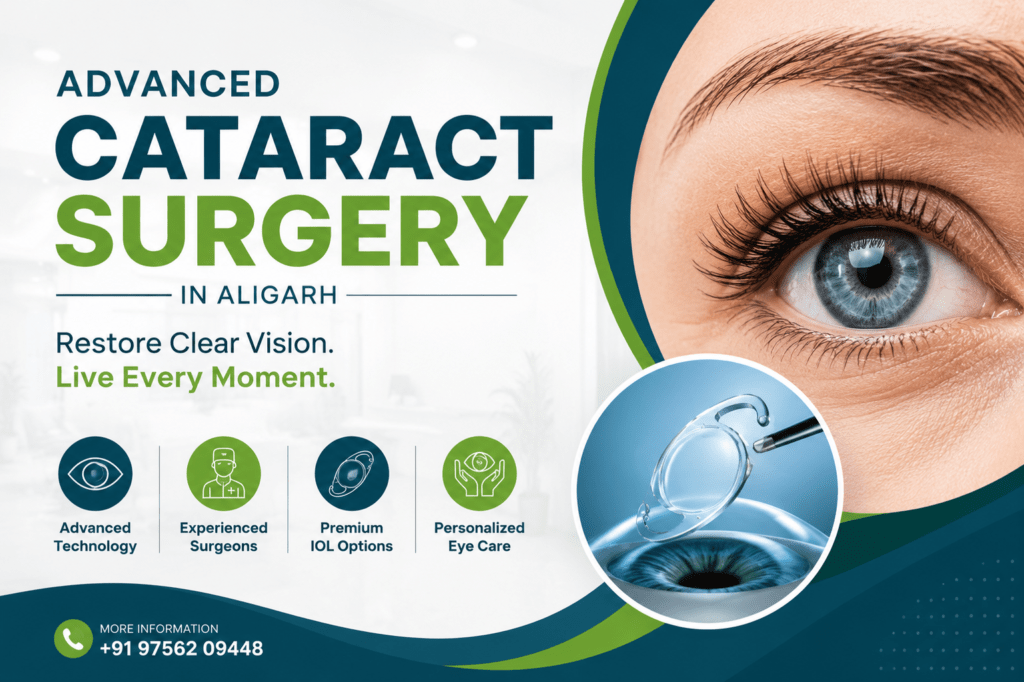
Clear vision plays an important role in almost every part of daily life—from reading and driving to recognising faces and moving around confidently. When a cataract develops, the natural lens inside the eye gradually becomes cloudy, which can make vision blurred, dull or less clear.
Cataracts commonly develop with age, although factors such as diabetes, eye injury and prolonged steroid use can also be associated with their development. Typical symptoms can include cloudy or blurred vision, glare around lights, difficulty seeing at night, faded colours and frequent changes in spectacle prescription.
For patients searching for cataract surgery in Aligarh, Ahuja Eye Centre provides dedicated cataract services using MICS cataract surgery, phacoemulsification technology, optical biometry and premium intraocular lens options.
What Is a Cataract?
The natural lens of a healthy eye is transparent and helps focus light onto the retina. A cataract develops when this lens becomes cloudy. As the cloudiness increases, light is scattered instead of being focused properly, which can reduce the clarity and quality of vision.
Cataracts usually progress gradually, which means many people may initially adjust to changes in their vision without immediately realising that a cataract is developing.
Common Signs That May Indicate a Cataract
An eye examination may be advisable if you are experiencing:
- Blurred, cloudy or hazy vision
- Difficulty seeing clearly at night
- Increased glare from headlights or bright lights
- Halos around lights
- Colours appearing faded or less bright
- Frequent changes in spectacle power
- Need for brighter light while reading
- Double vision in one eye
These symptoms are not exclusive to cataracts and may occur with other eye conditions as well, so an ophthalmic examination is important for an accurate diagnosis.
When Is Cataract Surgery Considered?
A cataract does not always require immediate surgery simply because it has been diagnosed.
In the early stages, changes in glasses or stronger lighting may help some patients manage their vision. Cataract surgery is generally considered when reduced vision begins affecting important everyday activities or when an ophthalmologist determines that surgery is appropriate for the patient’s eye condition and visual needs.
During cataract surgery, the cloudy natural lens is removed and replaced with an artificial intraocular lens, commonly called an IOL.
MICS Cataract Surgery at Ahuja Eye Centre, Aligarh
Ahuja Eye Centre specialises in MICS cataract surgery and lists the Stellaris Phaco Machine by Bausch + Lomb as part of its cataract surgery technology.
MICS stands for Micro-Incision Cataract Surgery. Phacoemulsification uses ultrasound energy to break the cloudy lens into small pieces so that it can be removed through a small incision before an artificial IOL is implanted.
The appropriate surgical approach is selected after evaluation of the patient’s eyes rather than using the same treatment plan for every patient.
Why Pre-Surgery Eye Measurements Matter
Successful cataract treatment is not only about removing the cloudy lens. Choosing an appropriate IOL power is also an important part of surgical planning.
Ahuja Eye Centre lists Optical Biometry as part of its cataract services and treatment technology.
Optical biometry provides measurements that help the ophthalmologist calculate the power of the intraocular lens required for an individual eye.
This allows cataract surgery planning to be personalised according to the patient’s ocular measurements and visual requirements.
IOL Options Available for Cataract Patients
After the cloudy natural lens is removed, an artificial intraocular lens is implanted.
Ahuja Eye Centre’s cataract services specifically list foldable and multifocal IOL implants, while Dr. Gayatri Ahuja’s profile confirms that the centre provides a range of premium intraocular lenses.
The most appropriate lens option can depend on factors such as:
- Eye health
- Existing refractive power
- Lifestyle
- Visual expectations
- Near and distance vision requirements
- Surgeon evaluation
Patients should discuss the advantages and limitations of available lens options with their cataract surgeon before making a decision.
Cataract & Refractive Expertise at Ahuja Eye Centre
Cataract services at Ahuja Eye Centre are headed by Dr. Gayatri Ahuja, Consultant Ophthalmologist, Cataract and Refractive Surgeon.
According to her official profile, Dr. Gayatri Ahuja is a trained phacoemulsification and refractive surgeon and has been heading the cataract and refractive services at Ahuja Eye Centre since 2001.
Her profile also notes the availability of a range of premium intraocular lenses at the centre.
For patients evaluating cataract treatment in Aligarh, consulting a surgeon who can assess both the cataract and the patient’s individual visual requirements is an important part of treatment planning.
Technology Supporting Cataract Care at Ahuja Eye Centre
Ahuja Eye Centre lists several technologies relevant to cataract evaluation and management, including:
Stellaris Phaco Machine
Used as part of the centre’s MICS cataract surgery setup.
Optical Biometry
Used for measurements required for IOL power planning.
Nidek A-Scan
Listed among the centre’s ophthalmic diagnostic technologies.
Zeiss Lumera I Microscope
Part of the treatment technology available at Ahuja Eye Centre.
Nd Laser
Ahuja Eye Centre lists YAG Laser Posterior Capsulotomy among its cataract services.
Having appropriate diagnostic and surgical technology allows the surgeon to plan treatment based on the individual characteristics of the patient’s eye.
What Happens After Cataract Surgery?
Recovery following cataract surgery can vary from patient to patient.
Patients are generally given specific instructions regarding prescribed eye drops, eye protection, follow-up visits and activities that should temporarily be avoided.
Following the surgeon’s post-operative instructions and attending scheduled follow-up appointments are important parts of the recovery process.
Patients should contact their ophthalmologist promptly if they experience unexpected or worsening symptoms after surgery.
Why Choose Ahuja Eye Centre for Cataract Surgery in Aligarh?
For someone researching advanced cataract surgery in Aligarh, Ahuja Eye Centre brings together several cataract-specific services on one platform:
- MICS cataract surgery
- Stellaris Phaco technology
- Optical Biometry
- Foldable and Multifocal IOL implants
- Range of premium IOL options
- YAG Laser Posterior Capsulotomy
- Dedicated Cataract & Refractive Surgeon
- Cataract and refractive services headed by Dr. Gayatri Ahuja since 2001
The choice of procedure and IOL should always be based on a detailed eye examination and individual assessment.
Frequently Asked Questions About Cataract Surgery
Can cataracts be removed with medicines or eye drops?
Medicines or eye drops do not remove an established cataract. In early stages, changes in glasses or lighting may temporarily help with vision, while surgery is the definitive way to remove the cloudy lens when treatment becomes necessary.
What is phacoemulsification cataract surgery?
Phacoemulsification is a cataract surgery technique in which ultrasound energy is used to break up the cloudy natural lens so that it can be removed through a small incision. An artificial intraocular lens is then implanted in its place.
Does Ahuja Eye Centre provide MICS cataract surgery in Aligarh?
Yes. Ahuja Eye Centre’s official Cataract Services page states that the centre specialises in MICS cataract surgery using the Stellaris Phaco Machine by Bausch + Lomb.
Are premium lens options available at Ahuja Eye Centre?
Yes. The centre lists foldable and multifocal IOL implantation, and Dr. Gayatri Ahuja’s official profile states that Ahuja Eye Centre’s cataract centre provides a range of premium intraocular lenses.
How do I know which IOL is right for me?
IOL selection depends on your eye measurements, eye health, refractive requirements and visual expectations. An ophthalmologist can recommend suitable options after a detailed examination.
Who handles cataract services at Ahuja Eye Centre?
Dr. Gayatri Ahuja is listed as a Consultant Ophthalmologist, Cataract and Refractive Surgeon and has headed cataract and refractive services at Ahuja Eye Centre since 2001.
Book a Cataract Consultation in Aligarh
If cloudy vision, glare, difficulty driving at night or frequent changes in spectacle power are affecting your everyday life, consider scheduling a comprehensive eye examination.
At Ahuja Eye Centre, Aligarh, the cataract team can evaluate your eyes, discuss whether surgery is appropriate and explain available surgical and IOL options according to your individual requirements.
Clearer vision begins with the right diagnosis and a treatment plan designed for your eyes.
Leave a reply
Leave a reply